

A trunk can hold only so much. Clothes, perhaps. A photograph. Something useful for the journey, something too precious to leave behind. Yet the battered luggage preserved at Chicago’s Swedish American Museum seems to carry a much larger question: how do you begin again without losing where you came from?
For 50 years, this Andersonville institution has helped Swedish America answer it. Founded in 1976, the museum celebrates its golden anniversary in 2026 with exhibitions and gatherings honouring the community that built it. Its achievement is measured in the lives it has documented, the objects it has protected and the generations it has brought together.
For those living between Sweden and America, that work feels particularly close to home. A familiar kitchen, a name on a travelling trunk, a pastry shared over coffee: the museum gives these ordinary things the attention they deserve. Through them, an enormous history becomes personal.
What they carried, and what they built
The museum’s core exhibition, We Are America, follows Swedish immigration to Chicago through recreated settings, artefacts and individual accounts. A steamship deck gives way to the places where life took shape afterwards: a Swedish cottage, a Swedish-American woodshop and a mid-century kitchen.
Among the people whose experiences it preserves are Elin and Birgitta Hedman, a mother and daughter who spent a night at Ellis Island waiting for Elin’s husband, and Anna Elisabet Martinsson, who travelled to America alone in 1925. Their stories restore names and circumstances to a movement so often described in numbers.

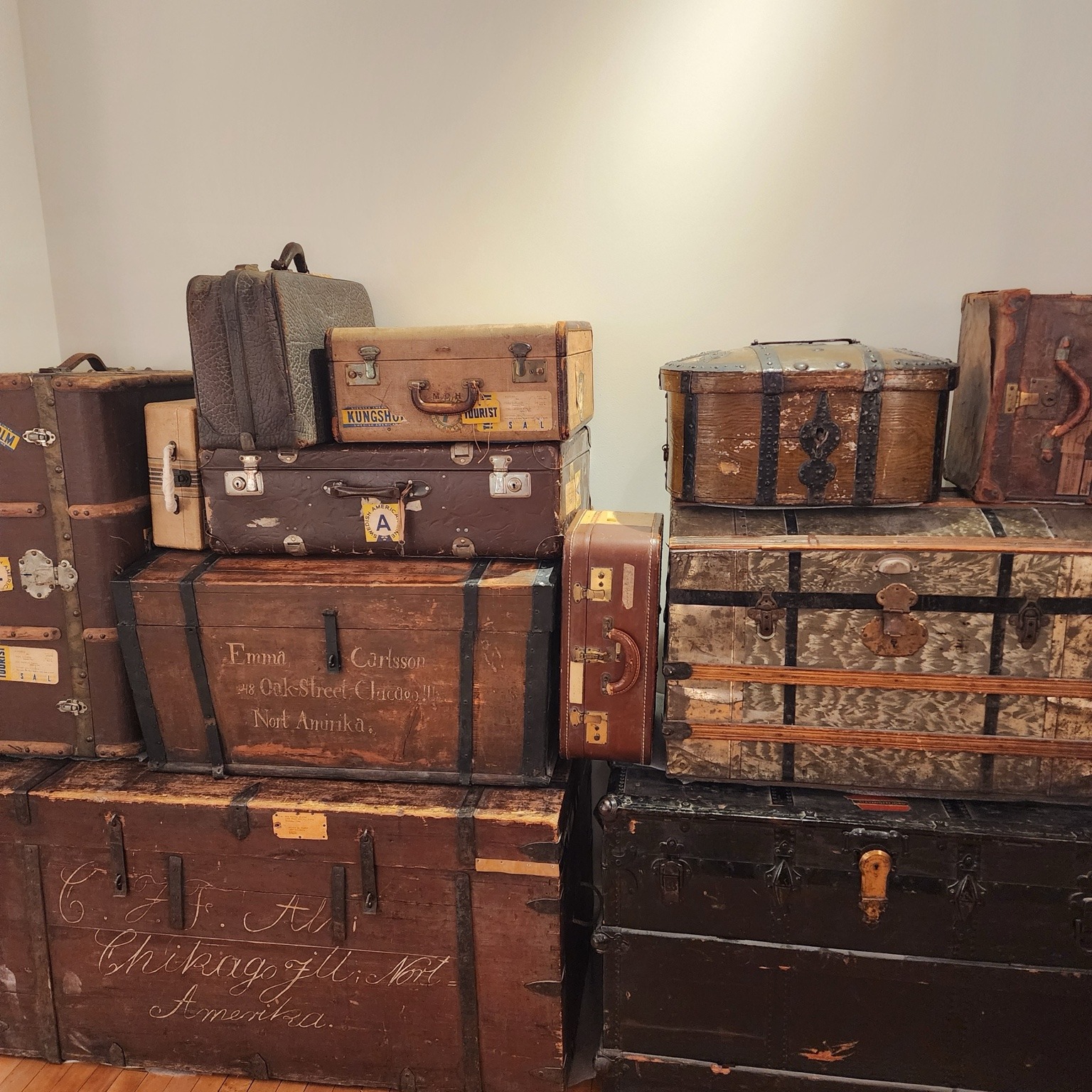
The trunks offer another way into that history. Their worn surfaces and handwritten destinations make the journey tangible. There is something profoundly moving about seeing a Chicago address on luggage that once belonged to someone preparing to cross an ocean. What was an unknown destination for one generation could become home for the next.
A kitchen, a coffee cup, a familiar pattern
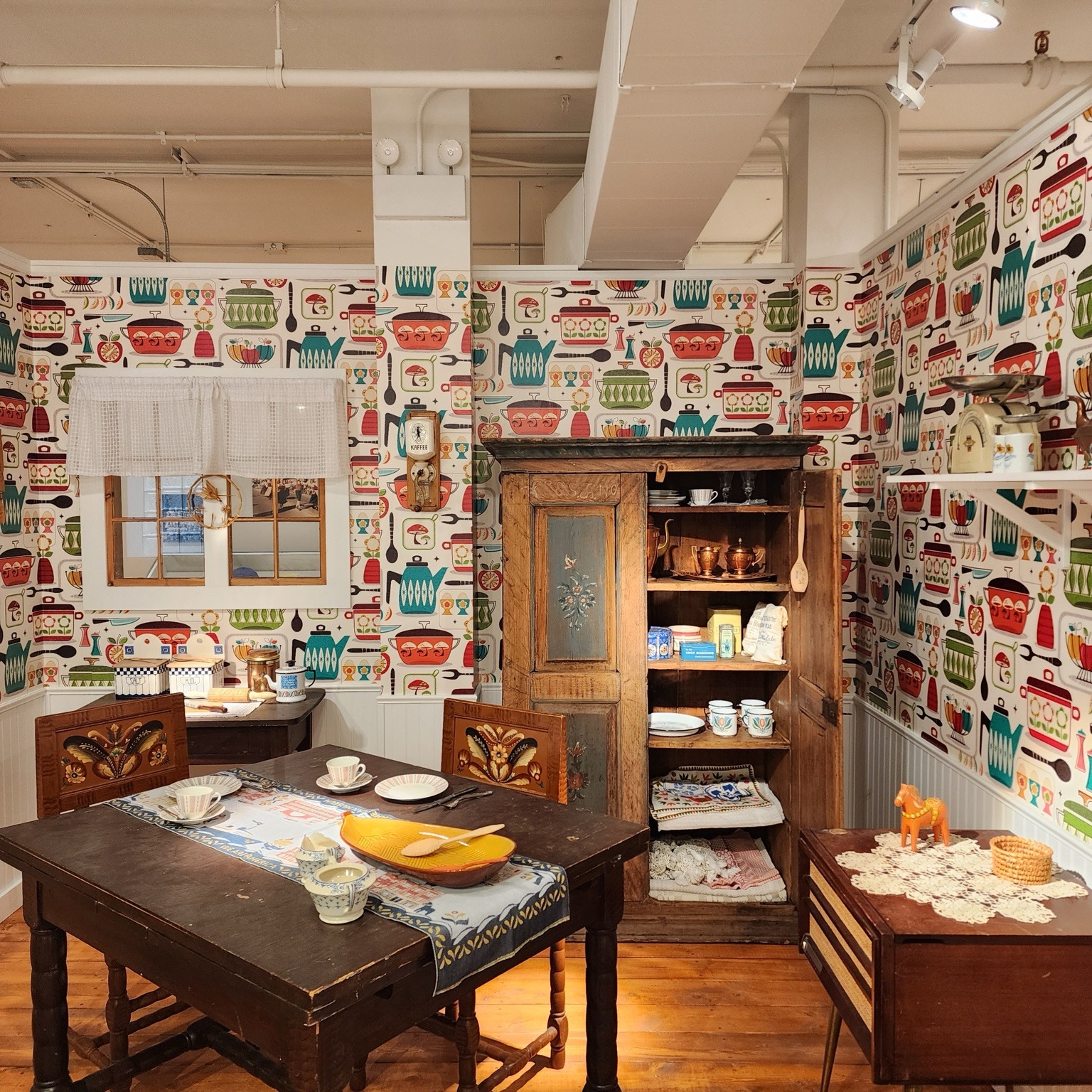
In the kitchen display, history settles into the objects of everyday life: cups and plates, a wooden table, patterned walls, a little Dala horse. It is easy to imagine why a visitor might pause here longer than expected. A familiar object can bring back a whole room, and a room can bring back a person.
For immigrants and their descendants, continuity often lives in such details. A way of setting the table. The things a family chooses to keep. A tradition repeated until it becomes part of American life, too. Giving that domestic world a place in a museum recognises the quiet work involved in making a home.
The hands that helped shape Chicago

The exhibition also explores Swedish-American architects, builders and craftspeople. The woodshop display, with its tools and workbench, brings attention to the skills immigrants carried alongside their belongings.
It broadens the story beyond departure and arrival. Building a life meant finding work, putting knowledge to use and contributing to a changing city. Here, Swedish-American history takes its place within Chicago’s history: in the homes people made, the work they undertook and the communities that formed around them.
A museum built by a community
The museum itself belongs to that story. Founder Kurt Mathiasson established it in 1976 through a community effort to preserve Swedish-American heritage. King Carl XVI Gustaf officially dedicated the institution that April, according to the museum’s anniversary history.

The archival photograph above records another royal visit. On October 17, 1994, the King visited the museum and signed a plaque for its Immigrant Wall. It is a memorable moment in the institution’s history, connecting the Swedish monarchy with a community whose lives and family histories had taken root across the Atlantic.
Over five decades, staff, volunteers, donors and visitors have sustained the museum’s work. Its anniversary is an opportunity to recognise that collective care: the decision to save a family object, share a story, teach a class or give time so that someone else can discover a connection.
A journey for the next generation

At the Brunk Children’s Museum of Immigration, younger visitors can explore the nineteenth-century journey from a Swedish farmhouse to a ticket booth, a steamship and, finally, a log cabin in Minnesota. Authentic artefacts and interactive settings help bring that experience within a child’s reach.
The children’s museum also includes a Viking ship and an area devoted to Swedish-American astronaut Buzz Aldrin and the Apollo 11 moon landing. Together, its spaces invite curiosity about travel, discovery and the lives people build far from their starting points.
Passing on heritage requires places where children can encounter it for themselves. Here, a family’s history can become something to explore together, with room for questions and play.
And then, a little fika

There is also a very Swedish reason to linger. Mormors Café serves Swedish pastries and savoury food, with seasonal specials celebrating Swedish holidays and food traditions. The museum has also hosted Semla Day pop-up cafés, bringing the cream-filled bun’s annual celebration to Chicago.
The gingerbread houses pictured here offer a glimpse of that festive spirit. Food gives people another way to participate: a taste they remember, a tradition they introduce to a friend, a reason to sit down together. A museum visit can become part of the everyday life of the community it serves.
Fifty years, with more stories to tell
The anniversary exhibition, 50 Years at the Swedish American Museum: Honoring our Roots, Cultivating Tomorrow, runs through November 29, 2026. It turns the museum’s attention to its own founders, milestones and community. The wider anniversary programme continues towards a closing celebration planned for March 2027.
Reaching 50 is an occasion to celebrate what has been preserved, and to consider what the next generation will need. The museum’s collection will meet visitors with different memories, different relationships to Sweden and new questions about belonging.
That is what makes this anniversary worth honouring. For half a century, the Swedish American Museum has made room for people to understand where they come from and what they share. May the next fifty years give many more families a place to find themselves in the story.
Plan a visit
The Swedish American Museum is at 5211 N. Clark Street, Chicago, Illinois, in Andersonville. The museum’s regular hours are Tuesday–Friday, 10 a.m.–4 p.m., and Saturday–Sunday, 11 a.m.–4 p.m.; it is closed Mondays. The café and children’s museum have separate schedules. Check current hours, admission and holiday closures before travelling, and consult the museum’s calendar for seasonal activities.
Photographs courtesy of the Swedish American Museum and Mormors Café. Archival royal-visit details supplied by the Swedish American Museum.


[…] you are planning a visit, explore our feature on the Swedish American Museum’s 50th anniversary and the immigrant stories preserved in its […]