
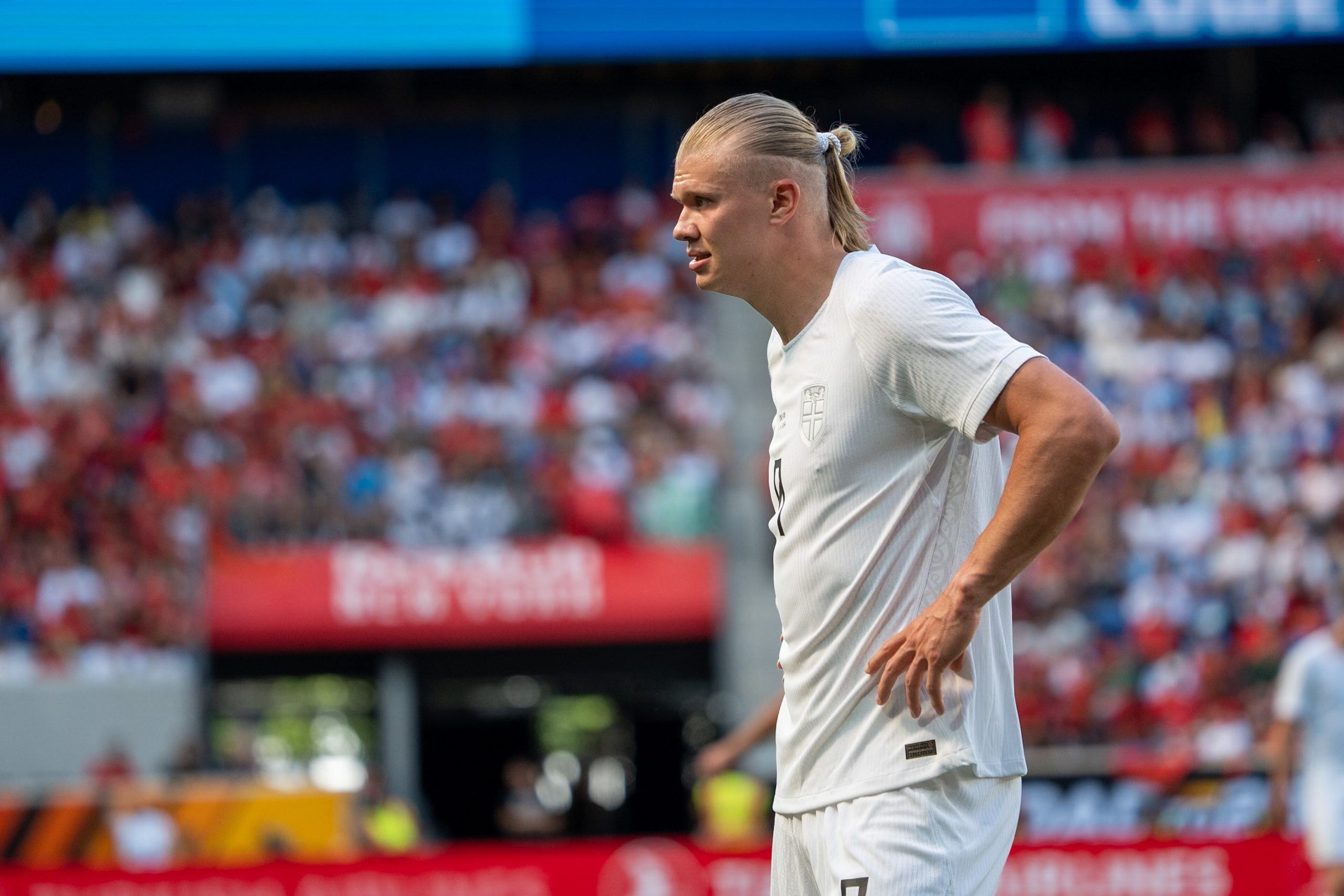
For years, Zlatan Ibrahimović held one of Scandinavian football’s most satisfying bragging rights. Not anymore.
Erling Haaland has officially overtaken the Swedish icon to become the highest-scoring Scandinavian man in international football history, after scoring twice in Norway’s 3-2 Nations League victory over Denmark on Thursday.
The brace took Haaland to 64 goals in just 56 appearances for Norway, moving him past Ibrahimović’s 62 goals in 122 matches for Sweden. According to Reuters, Haaland’s second goal, scored in the 74th minute, also sealed Norway’s first competitive victory over Denmark.
Nordic bragging rights, quite literally.
A Record That Puts Haaland in Rare Company
Zlatan’s 62-goal mark matters because of what it represented. For years, it stood as the highest men’s international total from Sweden, Norway or Denmark, and it belonged to one of the most recognizable Scandinavian footballers of the modern era.
Haaland has now moved beyond it with 64 goals in 56 appearances. The comparison is useful mostly because it shows just how extraordinary the Norwegian’s scoring pace has become.
But the more interesting story is Haaland himself.
From Bryne to the Biggest Stage
Haaland’s rise did not begin in Manchester, Dortmund or even Salzburg. It began in Bryne, the small Norwegian town where he grew up after being born in Leeds in 2000 while his father, Alfie Haaland, was playing in England.
He came through Bryne FK’s youth system and made his senior debut as a teenager before moving to Molde. From there came the increasingly familiar sequence: Red Bull Salzburg, Borussia Dortmund and, in 2022, Manchester City.
At every stop, the pattern was remarkably similar. Haaland arrived, adjusted quickly and started scoring at a rate that made whatever had come before look almost modest.
Manchester City’s own career profile describes him as a goalscorer who had already built a formidable reputation in Norway, Austria and Germany before arriving in England. By the time City signed him, he was no longer simply one of Europe’s most promising strikers. He was already one of its most feared.
Manchester City, and a Career Built on Records
His first season in England was almost absurd.
Haaland scored 36 Premier League goals in 2022/23, breaking the competition’s single-season scoring record and helping Manchester City win the Premier League, FA Cup and Champions League treble. It was the kind of debut season that would normally define a career.
Instead, it became the starting point.
By the end of the 2025/26 season, Haaland had won the Premier League Golden Boot for a third time, finishing the campaign with 27 league goals. Only Thierry Henry and Mohamed Salah have won the award more often.
In Europe, the numbers are just as striking. Haaland became the fastest player in Champions League history to reach 50 goals, and UEFA’s record books have followed his scoring milestones almost from the moment he arrived in the competition.
There is something almost mechanical about the way he accumulates goals. Not joyless, exactly. Just relentless.
Then Came the 2026 World Cup
For Norway, Haaland’s club success had always come with one obvious question: what would happen if he finally got the chance to do it on the World Cup stage?
In 2026, he got his answer.
Norway returned to the World Cup for the first time in 28 years, after a perfect qualifying campaign in which Haaland scored 16 goals. FIFA credited him as one of the central forces behind Norway’s return to the tournament.
He then scored seven goals at his first World Cup, helping Norway reach the quarter-finals. That included two goals against Senegal in the group stage, the winner against Côte d’Ivoire in Norway’s first-ever World Cup knockout victory, and another brace against Brazil in the Round of 16. FIFA’s final tournament statistics placed him among the competition’s leading scorers.
For a country that had not appeared at a World Cup since 1998, it was not merely a successful tournament. It felt like the arrival of a new Norwegian football era.
One Important Scandinavian Footnote
There is one distinction worth making.
Haaland now holds the men’s Nordic international scoring record. The overall Nordic international record belongs to another Swede: Lotta Schelin, who scored 88 goals for Sweden’s women’s national team.
So Sweden has lost one regional record to Norway, but not all of them.
Very Scandinavian indeed.
So, What Makes Haaland So Difficult to Stop?
The obvious answer is his size. At 6-foot-4, Haaland has the frame of a traditional centre-forward and the speed of someone who really should not be able to move that quickly.
But the goals are not simply the product of strength or pace. Much of Haaland’s game is about movement: drifting away from defenders, attacking the space between centre-backs, and arriving in the right place a fraction of a second before everyone else.
After the Denmark match, Norway manager Ståle Solbakken suggested that instinct is the part that cannot really be coached. As Reuters reported, Solbakken’s assessment was wonderfully simple: Haaland was “born with it.”
Haaland himself tends to make the extraordinary sound far less dramatic. In interviews with Manchester City, he has repeatedly emphasized routine, work and the next game rather than records. Speaking about his development, he described himself as essentially the same person, just with more experience.
The statistics suggest that experience is working rather well.
And He Is Still Only 26
That may be the most remarkable part of the record.
Haaland’s 64th international goal did not come at the end of a long career. It came at 26, after a summer in which he had just scored seven goals at his first World Cup.
There is no sensible way to know where the number eventually ends, and records have a habit of looking permanent right up until somebody breaks them. For now, 64 is the new Scandinavian men’s benchmark.
More importantly, Haaland’s career has become bigger than a collection of scoring records. He helped take Norway back to a World Cup after 28 years, carried them deep into the tournament, and has become one of the most recognizable footballers in the world while still representing a country of barely more than five million people.
For Norway, he is already a once-in-a-generation player. For Scandinavian football, he is becoming something even bigger.
Congratulations, Erling. The Scandinavian scoring crown is yours. 🇳🇴
Featured image: Bryan Berlin / WikiPortraits, CC BY-SA 4.0.


