
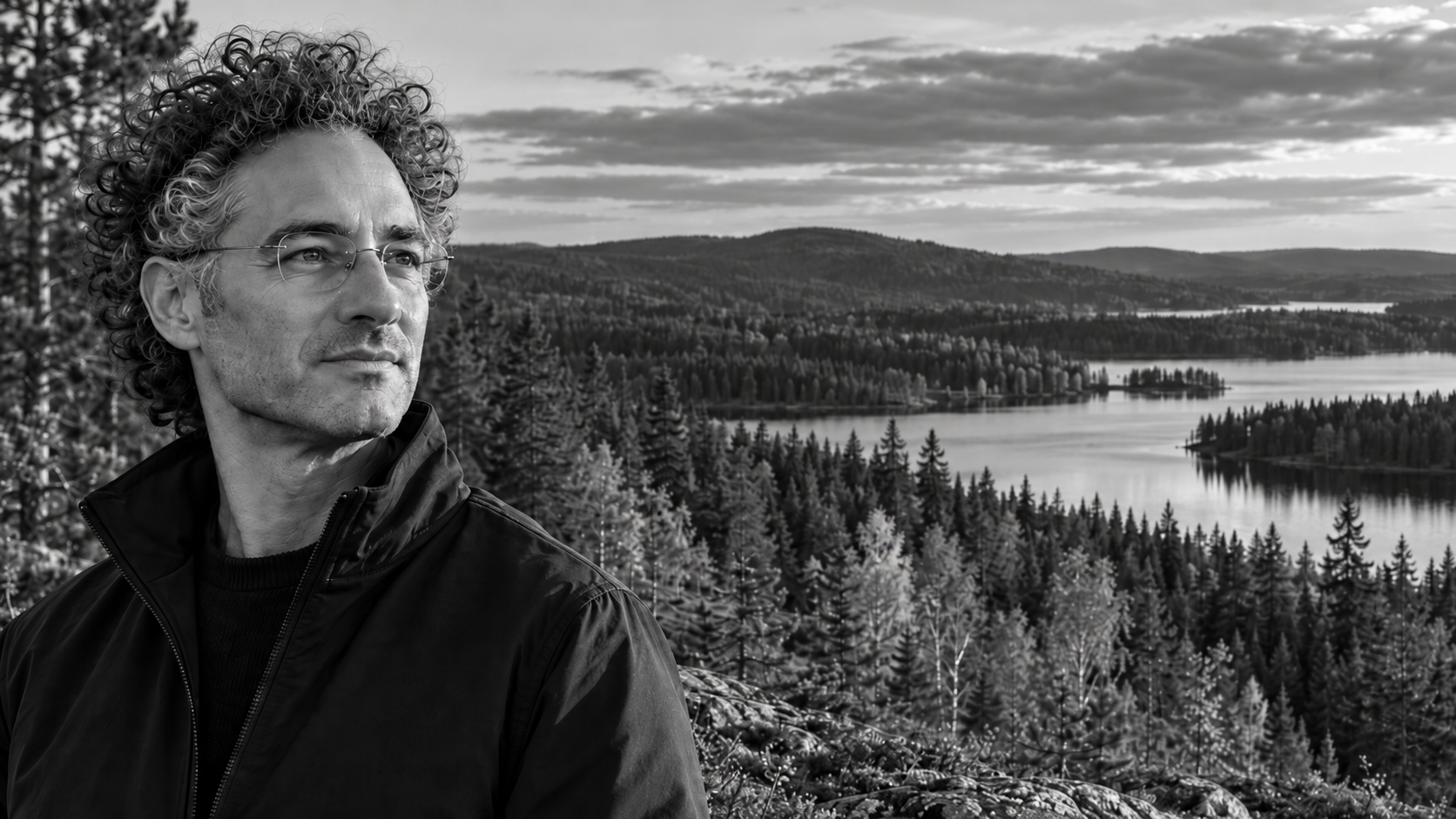
Let’s address the elephant in the room: if you have been following Swedish news over the past few days, you have probably already seen the headline.
Alex Karp, co-founder and CEO of American software company Palantir, has bought roughly 15,000 hectares of land in Härjedalen in northern Sweden. The deal, made through the newly established Swedish company Cladonia Skog AB, is reported to be worth around SEK 240 million.
That is an enormous amount of land. According to SVT, the property is comparable in area to the land area of Malmö Municipality and sits south of Storsjö Kapell in Berg Municipality, bordering Storsjön.
But the more interesting question is not whether Karp bought it.
It is why.

So what is Alex Karp planning to do with it?
So far, the official explanation is considerably less dramatic than some of the speculation surrounding the purchase.
Sveriges Radio reported that Cladonia Skog’s stated ambition is to manage the area through careful forestry that takes plant and animal life into account. The company has also explicitly rejected speculation that Karp might be planning to build a data center on the property. In a statement reported by SVT, a representative speaking on behalf of Cladonia Skog said the data-center speculation lacked basis.
The stated plan is forestry and land management, not a new Palantir facility. Process Nordic likewise reported that there were no plans for a data center and that the new owner intended to manage the land carefully and over the long term.
The purchase has nevertheless raised questions locally, not least because of its size. Skogsaktuellt reported that the deal also includes hunting rights and that existing hunting arrangements in parts of the area are being affected.
There is another detail that puts the price into perspective. SCA has said that much of the land is not particularly well suited to conventional forestry and consists largely of mountain terrain. That helps explain why the per-hectare price looks relatively low compared with productive forest elsewhere in Sweden. EFN reported SCA’s description of the property as being, to a large extent, bare mountain land.
It is not Karp’s first unusual property purchase
At first glance, an American technology billionaire buying tens of thousands of acres of Swedish wilderness sounds unusual. Maybe even a bit concerning.
But a quick look at Karp’s previous property purchases makes the acquiring of the enormous Swedish plot less concerning.
In late 2025, Karp reportedly paid $120 million for St. Benedict’s Monastery near Aspen, Colorado. The former Trappist monastery spans roughly 3,700 acres and includes a monastery building, retreat center, houses, cabins, and large stretches of undeveloped land.
The Wall Street Journal reported that the buyer planned to use the property as a home. Aspen Journalism later reported that Karp had said he intended to work with the previous users of the property to continue caring for the land.
That purchase alone suggests a taste for properties that are less about conventional luxury and more about seclusion, space, and access to nature.
A 500-acre New Hampshire estate and a Miami compound
Karp has also been reported to live on a roughly 500-acre estate in Lyman, New Hampshire, a rural property far removed from the typical Silicon Valley executive lifestyle. He is known for spending significant time outdoors and has spoken repeatedly about his enthusiasm for cross-country skiing.
His portfolio is not exclusively wilderness, though.
Karp has also been linked to two neighboring waterfront properties on San Marino Island in Miami Beach. One was purchased for about $46 million, followed by the neighboring property for another $28.5 million. Realtor.com reported that the two purchases appear to be intended as a larger waterfront compound.
It makes for an unusual collection: a rural New Hampshire estate, a former monastery in the Colorado mountains, a Miami waterfront compound, and now an enormous stretch of land in Härjedalen.
Why Härjedalen?
This is the part that remains unanswered.
There are obvious reasons someone with Karp’s interests might be drawn to the area. Härjedalen offers mountains, forests, lakes, skiing, privacy, and enormous stretches of relatively untouched nature.
The property is also not simply recreational land. It is a real forestry and landholding asset. Cladonia Skog has said that the area will be managed through careful forestry, meaning the purchase can function as a long-term land investment while also preserving access to a vast private landscape.
But whether Karp ultimately sees the property as an investment, a conservation project, a recreational retreat, a future residence, or some combination of those has not been publicly confirmed.
What we do know is that the company says the land will continue to be managed through forestry, that Swedish authorities approved the acquisition, and that the company has rejected speculation about a data center.
And owning the land does not mean closing it off
There is also a distinctly Swedish dimension to the story.
Even though the property is privately owned, Sweden’s Allemansrätten, the Right of Public Access, generally allows people to walk, ski, and spend time in nature on privately owned land, provided they respect homes, cultivated land, wildlife, and any local restrictions.
So Karp may now control an extraordinary piece of Härjedalen, but that does not necessarily mean the public suddenly loses access to 15,000 hectares of Swedish wilderness.
For now, the most interesting part of the story is the uncertainty. One of America’s most prominent technology executives has bought a piece of Sweden on a scale few private buyers ever do. His previous purchases suggest that remote, expansive properties are hardly new territory for him.
Whether the land in Härjedalen becomes primarily a forestry investment, a retreat, a conservation-minded holding, or something else entirely, remains to be seen.
Featured image: Alex Karp in Davos, January 2026. Photo: Isaac Castillo / Presidencia de la República del Ecuador. Public domain via Wikimedia Commons.


